
Studying what wins attention in your niche isn’t about copying—it’s about spotting gaps, raising the bar, and moving faster with confidence. If you want to use competitor analysis to find content ideas, here’s a practical, ethical workflow that turns outside signals into an on-brand editorial pipeline.
How do I get content ideas from competitor data?
Short answer: collect the pages your rivals publish, strip each one down to five signals — topic, angle, format, freshness, engagement — and write down what is missing rather than what is there. Every gap becomes a brief, and the briefs get ranked before anyone writes a word. That loop, in five moves:
- Name your real rivals. Business, SERP, and audience competitors are three different lists, and the last two usually matter more.
- Log 10–20 of their strongest pages a month: headline, format, publish and update dates, and a one-line note on why it works.
- Read each page through the five lenses below and record the hole, not the highlight.
- Turn each hole into a brief with a stated reason you will win it — better data, sharper angle, or a format nobody has shipped.
- Score the briefs on impact, confidence, and effort, then publish the top three and leave the rest in the backlog.
What follows is each move in detail, with the sheet columns and the scoring maths.
Blog competitor analysis: define your true rivals
List competitors in three buckets:
- Direct business competitors: sell the same thing to the same audience.
- SERP competitors: sites that consistently outrank you for priority topics (media, marketplaces, aggregators). Tools like Ahrefs and Semrush help map these.
- Audience competitors: creators your buyers follow (newsletters, YouTube channels, community blogs). Use SparkToro to see who influences your audience.
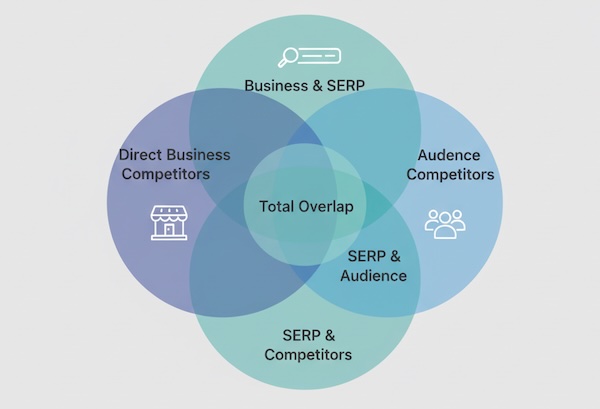
The second and third buckets often reveal more about attention than your traditional vendor set.
Competitive content analysis: the five lenses
Scan your rivals weekly or monthly through these lenses and log findings in a simple sheet:
- Topics & taxonomy
Which clusters dominate (beginner guides, use cases, comparisons, benchmarks)? Where are the obvious topic holes? - Depth & angle
Do they skim the surface or show working (data, screenshots, methodologies)? What unique POVs or narratives do they use? Backlinko’s case study on out-depthing a page that already ranks is a useful reference for which kind of depth attracts links. - Format & UX
Long-form guides, templates, calculators, checklists, video. Is the format matched to search intent? - Freshness & velocity
How often do they update? Which posts get timely refreshes (new year, new research, product changes)? - Engagement signals
Backlinks, social shares, comments, time on page, internal links, TOC usage. Similarweb can provide directional traffic and referral context.

Turn competitor signals into reusable idea templates
Turn observations into repeatable idea templates your writers can grab:
- Angle gaps: “Most guides list features; we’ll show decision criteria with trade-offs and real screenshots.”
- Format gaps: “Competitors write about ROI; we’ll ship a calculator + downloadable model.”
- Audience gaps: “They target beginners; we’ll publish an advanced, practitioner-first playbook.”
- Evidence gaps: “Replace claims with mini-studies, anonymized benchmarks, or cohort charts.”
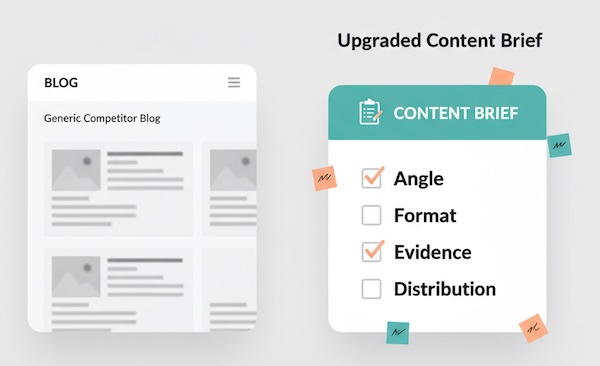
Pair every template with an example URL and a crisp brief (goal, audience, search intent, outline, differentiators). For packaging ideas, see HubSpot.
Where to look (fast, free, and ethical)
- Search results: Map page-1/2 for priority terms; capture headings and SERP features (People Also Ask, video, snippets).
- Newsletters & social: Identify posts with high saves/shares; note angles that sparked discussion. Scheduling and repurposing are easier with Buffer or Hootsuite guides.
- Communities/Q&A: What problems recur? Turn them into FAQs, teardowns, decision trees.
- Your analytics: High entrances with weak engagement flags a page that already has demand and a bad answer. Running a content audit to find the WordPress posts worth updating often surfaces more usable briefs than a rival’s blog does.
Yes, this is website competitive analysis—but applied to content inventory, not just features.
From signals to briefs: the Idea Grid
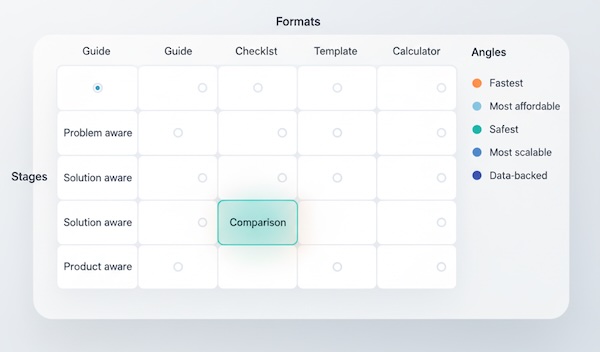
Create a simple 3×5 grid to multiply ideas without reinventing the wheel:
- Stages: Problem aware → Solution aware → Product aware.
- Formats: Guide, checklist, comparison, template, calculator.
- Angles: Fastest, most affordable, safest, most scalable, data-backed.
Pick one from each column to spin out differentiated posts—for example, Solution-aware × Template × Most affordable: “Budget Planning Template: Prioritize High-Impact Tactics in 30 Minutes.”
Prioritize with ICE—Impact, Confidence, Effort
Score each idea 1–5 on:
- Impact: Search volume + business relevance + internal linking potential.
- Confidence: Proof that this angle/format resonates (competitor performance, audience asks).
- Effort: Time and resources (research, design, data).
Publish high-ICE first. Low-effort, high-impact “remix” posts (updates, consolidations, comparison expansions) often ship fastest.
Blog analysis cadence that compounds
Set a lightweight monthly rhythm:
- Collect: Add 10–20 standout competitor URLs, headlines, and quick notes to your tracker.
- Cluster: Group by topic; identify under-served or over-served clusters.
- Decide: Pick 3–5 briefs using ICE.
- Differentiate: Document why you’ll win (unique data, POV, format, distribution).
- Publish & measure: Watch rankings, engagement, and assisted conversions—not just pageviews.
This ongoing blog analysis keeps your backlog market-tuned without whiplash.
Ethical guardrails (and why they help)
- No copy-pasting structures verbatim. Start from the user problem and your POV; cite sources when relevant.
- Avoid me-too content. If you can’t clearly explain how your version is better or different, skip it.
- Respect trademarks and visuals. Use your own screenshots/assets; request permission when needed.
Originality is a moat; ethics protect it.
Sample briefs born from competitor gaps
- “The Honest Comparison”
Gap spotted: Competitors avoid head-to-head matchups.
Brief: A transparent comparison with decision criteria tables, use-case fit, and break-even math. - “Checklist + Calculator Combo”
Gap spotted: Everyone talks ROI, no one quantifies.
Brief: Interactive calculator (downloadable), plus a setup checklist tied to each input. - “Advanced Practitioner Guide”
Gap spotted: Flood of beginner content; little depth.
Brief: In-the-weeds tactics, pitfalls, annotated examples, and common failure modes. - “From Data to Narrative”
Gap spotted: Dry benchmarks; no story.
Brief: Cohort charts + narrative explaining why outcomes diverge, with actions per segment.
Distribution—don’t bury good ideas
Great content that nobody sees doesn’t count. Before drafting, write the distribution plan: internal links to key pages, 3–5 social riffs, 1–2 newsletter angles, and one community conversation you’ll contribute to. Re-promote after updates.
Metrics that prove you’re winning
Tie performance to business, not vanity:
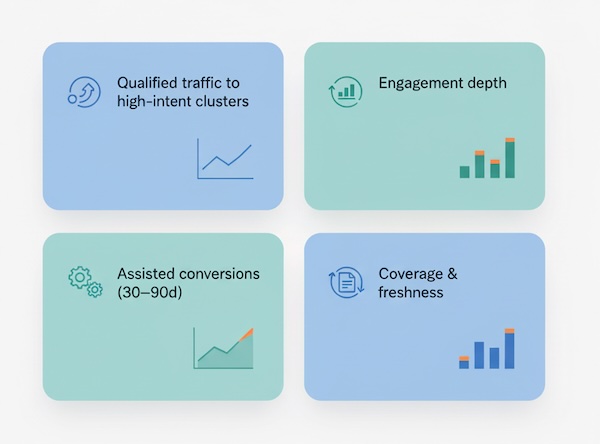
- Qualified traffic growth to high-intent clusters (rankings + entrances).
- Engagement depth: scroll, time on page, next-page click-through to BOFU content.
- Assisted conversions: content’s role in deals or purchases over 30–90 days.
- Coverage & freshness: share of your core clusters with a best-in-class asset, updated at least twice a year.
Putting it all together
A smart blog competitor analysis isn’t spying; it’s listening. By systematizing competitive content analysis—and turning observations into differentiated briefs—you’ll publish fewer me-too articles and more pieces your audience actually needs. Use this approach to use competitor analysis to find content ideas, then let your expertise and evidence do the heavy lifting.
Keep the tracker, the Idea Grid, and the ICE scores in one document. Six months from now that file is how you — or whoever inherits the blog — will remember why a topic was chosen and what the bet was. It also turns the next round of blog analysis into a half-hour job instead of a fresh start.

Written by Ellie
Former Head of Analytics at a European digital agency. 8+ years making WordPress analytics make sense. Google Analytics certified. I write the guides I wish existed when I started.
More about me →