Your paid ad brought someone to your site. A week later, they clicked an email link. Then they searched your brand name and converted. Which channel gets the credit?
If you’re using last-click attribution, the answer is “branded search” — and your paid ads look like a waste of money. That’s a problem. Linear attribution offers a different approach: split the credit equally across every touchpoint. Simple, fair, and surprisingly useful in the right context.
In this guide, I’ll explain how linear attribution works, when it makes sense, and when you should pick a different model instead.
What Is a Linear Attribution Model?
A linear attribution model is a multi-touch attribution approach that distributes conversion credit equally across all touchpoints in the customer journey. If a user interacts with four channels before converting, each channel receives 25% of the credit.
Here’s the formula:
Credit per touchpoint = 100% ÷ Number of touchpoints
For example, imagine this journey:
- Facebook Ad → First click, discovers your product
- Blog post (SEO) → Returns via organic search, reads a guide
- Email newsletter → Clicks a promo link
- Direct visit → Types your URL and converts
With linear attribution, each touchpoint receives 25% credit for the conversion. No channel is ignored. No channel is overvalued.
Linear Attribution vs. Other Models
Linear is one of several attribution models. Here’s how it compares:
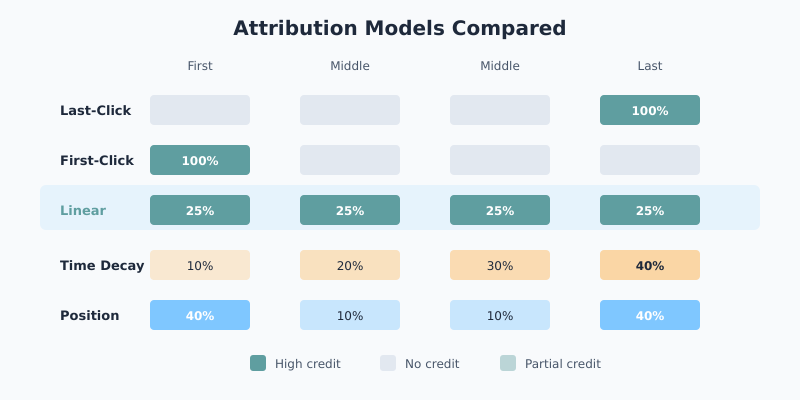
| Model | How Credit Is Distributed | Best For |
|---|---|---|
| Last-Click | 100% to final touchpoint | Short sales cycles, direct response |
| First-Click | 100% to first touchpoint | Brand awareness campaigns |
| Linear | Equal credit to all touchpoints | Balanced view, content marketing |
| Time Decay | More credit to recent touchpoints | Short consideration periods |
| Position-Based (U-Shaped) | 40% first, 40% last, 20% middle | Lead generation with nurturing |
| Data-Driven | ML-based, varies by journey | Large datasets, complex funnels |
Linear sits in the middle — it’s more nuanced than single-touch models but simpler than algorithmic approaches. That’s both its strength and its limitation.
How Linear Attribution Works: A Practical Example
Let’s say you run an online store selling productivity software. A customer named Alex converts after this journey:
| Touchpoint | Channel | Cost | Linear Credit (25%) |
|---|---|---|---|
| Day 1 | Google Ads (non-brand) | $2.50 CPC | $24.75 |
| Day 4 | Retargeting Ad | $0.80 CPC | $24.75 |
| Day 7 | Email (nurture sequence) | ~$0.02 | $24.75 |
| Day 10 | Direct visit → Purchase ($99) | $0 | $24.75 |
With linear attribution, you can calculate true ROAS per channel:
- Google Ads: $24.75 revenue ÷ $2.50 cost = 9.9x ROAS
- Retargeting: $24.75 ÷ $0.80 = 30.9x ROAS
- Email: $24.75 ÷ $0.02 = 1,237x ROAS
- Direct: $24.75 ÷ $0 = ∞ (but required prior touchpoints)
Compare this to last-click attribution, which would give 100% credit ($99) to “Direct” — making your paid campaigns look worthless.
When to Use Linear Attribution
Linear attribution works best in specific scenarios. Here’s when it makes sense:
1. Content Marketing and SEO
If you invest heavily in blog content, linear attribution ensures those top-of-funnel articles get credit. Last-click models systematically undervalue content that introduces users to your brand but doesn’t directly convert them.
2. Long Sales Cycles
B2B products, SaaS subscriptions, and high-ticket items often involve 5-15+ touchpoints over weeks or months. Linear attribution prevents any single touchpoint from dominating the narrative.
3. Omnichannel Campaigns
Running ads on Facebook, Google, LinkedIn, and email simultaneously? Linear helps you see how each channel contributes without overweighting the final click.
4. Early-Stage Analysis
If you’re just starting with multi-touch attribution, linear is a solid baseline. It’s easy to understand, easy to explain to stakeholders, and provides a more balanced view than single-touch models.
5. Equal Budget Allocation
When you want to maintain balanced investment across channels rather than chasing the “last click winner,” linear supports that strategy.
When NOT to Use Linear Attribution
Linear attribution isn’t always the right choice. Avoid it in these situations:
1. Short, Impulse-Driven Sales Cycles
If customers typically convert in one or two sessions (e.g., low-cost e-commerce), linear adds complexity without much insight. Last-click or first-click may be sufficient.
2. When Touchpoints Clearly Have Different Impact
Sometimes a specific touchpoint — like a product demo or a phone call with sales — is obviously more influential. Linear would undervalue that critical moment by giving it equal weight to a banner ad impression.
3. Large Datasets with Quality Data
If you have enough conversion data (typically 300+ conversions per month), data-driven attribution will outperform linear by learning actual touchpoint influence from your specific data.
4. Google Ads Campaigns
Note: Google deprecated linear attribution in Google Ads in 2023, moving to data-driven attribution as the default. You can still use linear in Google Analytics 4 and other platforms, but not for Google Ads conversion tracking.
Linear Attribution by Business Type
Here’s how linear attribution applies to different business models:
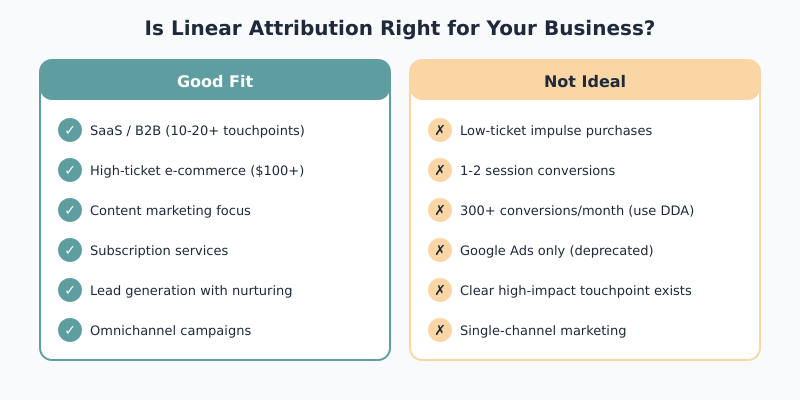
| Business Type | Typical Journey Length | Linear Attribution Fit | Alternative to Consider |
|---|---|---|---|
| SaaS / B2B | 10-20+ touchpoints | Good | Position-based or data-driven |
| E-commerce (high-ticket) | 5-10 touchpoints | Good | Time decay |
| E-commerce (low-ticket) | 1-3 touchpoints | Overkill | Last-click |
| Lead Generation | 3-8 touchpoints | Good | Position-based |
| Mobile Apps | 2-5 touchpoints | Moderate | First-click for install campaigns |
| Subscription Services | 5-15 touchpoints | Good | Data-driven if enough volume |
Pros and Cons of Linear Attribution
Advantages
- Fair representation: Every channel gets recognized for its role
- Easy to understand: No complex algorithms or black boxes
- Reveals the full funnel: Shows how awareness channels contribute to conversions
- Good for team alignment: No channel “loses” in the attribution game
- Platform agnostic: Works across any analytics tool
Disadvantages
- Oversimplification: Not all touchpoints are equally influential
- Ignores timing: A touchpoint 30 days ago gets same credit as yesterday
- Can mask poor performers: Weak channels still get equal credit
- Not data-driven: Doesn’t learn from your actual conversion patterns
- Deprecated in Google Ads: No longer available for Ads conversion tracking
How to Set Up Linear Attribution
Here’s how to implement linear attribution in popular platforms:
Google Analytics 4
GA4 supports linear attribution in its attribution settings.
- Go to Admin → Attribution Settings
- Under “Reporting attribution model,” select Linear
- Choose your lookback window (default: 30 days for acquisition, 90 days for other events)
- View results in Advertising → Attribution → Model Comparison
Tip: Use GA4’s Model Comparison report to see how linear differs from last-click and data-driven models for your data.
Matomo
- Navigate to Goals → Attribution
- Select the goal you want to analyze
- Choose Linear from the attribution model dropdown
- Review channel credit distribution
Other Platforms
Most analytics and marketing platforms support linear attribution:
- Adobe Analytics: Attribution panel → Linear model
- HubSpot: Attribution reports → Linear model option
- Ruler Analytics: Built-in multi-touch models including linear
Comparing Your Results: Linear vs. Last-Click
Once you’ve set up linear attribution, compare it to your existing model. Here’s what to look for:
| If Linear Shows… | It Means… | Action |
|---|---|---|
| SEO/Content gets more credit | Top-of-funnel is undervalued | Consider increasing content investment |
| Paid social gets more credit | Awareness campaigns drive conversions | Don’t cut social based on last-click data |
| Email gets less credit | Email may be a “closer” not “introducer” | Test position-based for comparison |
| Results are similar to last-click | Short journeys with few touchpoints | Last-click may be sufficient for you |
Linear Attribution: The Bottom Line
Linear attribution is the “equal opportunity” model — every touchpoint gets the same credit, no questions asked. That fairness is both its greatest strength and its biggest weakness.
Use linear attribution when:
- You want a balanced view across all channels
- Your sales cycle involves multiple touchpoints over time
- You’re starting with multi-touch attribution and need a simple baseline
- You invest heavily in content marketing or brand awareness
Skip linear attribution when:
- Your conversions happen in one or two sessions
- You have enough data for data-driven attribution (300+ monthly conversions)
- Certain touchpoints are clearly more influential than others
No attribution model is perfect. Linear gives you a clearer picture than last-click, but it’s still a simplification. The best approach? Compare multiple models, understand their trade-offs, and pick the one that aligns with how your customers actually buy.